
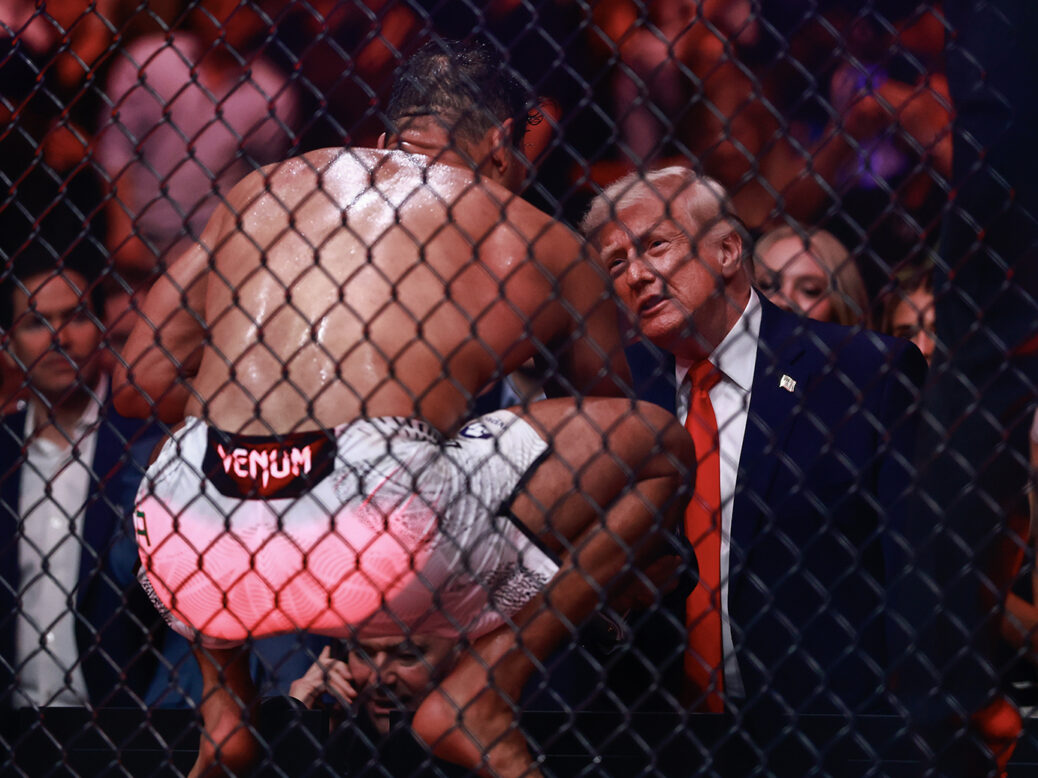
Donald Trump has always had a knack for theatrics. From his days playing a billionaire businessman in front of screaming crowds at WrestleMania to his decade playing the same role as the host of The Apprentice, Trump prides himself on knowing how to project strength and power on screen. So it was presumably not a coincidence that when Vice-President JD Vance was announcing the failure of talks with Iranian officials in Islamabad on 11 April, Trump was making his entrance at an Ultimate Fighting Championship (UFC) cage match in Miami.
The US president strode out to the expletive-strewn lyrics of Kid Rock’s “American Badass”, trailed by Secret Service agents and several of his children and grandchildren, to take his seat in the front row. The US secretary of state, Marco Rubio, who is also the acting national security adviser, periodically interrupted, leaning in to show Trump something on his phone, while the mixed martial arts fighters in front of them grappled and kicked each other in the blood-spattered ring. On his way to Florida earlier that evening, Trump had insisted that the outcome of talks with Iran did not matter to him. “We win regardless,” he announced on board Air Force One. “We’ve defeated them militarily.”
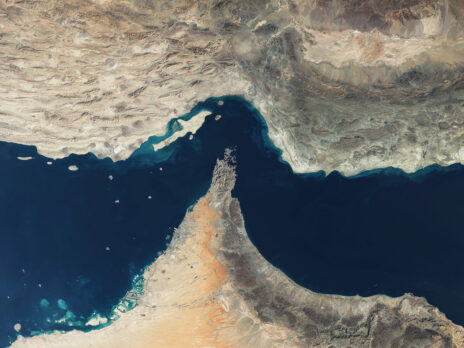
By the following morning, it seemed those talks did matter after all. Despite having repeatedly declared victory over Iran in previous weeks and insisted that their military capabilities had been destroyed, Trump said he had ordered the US Navy to begin blockading the Strait of Hormuz. He said the navy would also “seek and interdict every vessel in international waters” that had paid a toll to Iran, raising the prospect of US warships hunting down tankers belonging to US allies and adversaries alike, and questions about how, exactly, the US would determine which vessels had paid Tehran, which has reportedly demanded payment in anonymous Bitcoin. But these were mere details to be worked out later. The main message the president wanted to deliver was that the US was “LOCKED AND LOADED”, poised to “finish up the little that is left of Iran”.
Trump has reason to believe brinkmanship works. After he warned on 7 April that a “whole civilisation will die tonight, never to be brought back again”, Tehran agreed to a ceasefire. Chinese diplomats reportedly played a crucial role behind the scenes, urging their Iranian counterparts to enter negotiations and explore a deal, although China’s foreign ministry has refused to confirm this. This might well have caused Trump to assess that his apocalyptic threats worked, and assume that Beijing will pressure Tehran to back down again this time as it stands to lose from a US blockade of Hormuz.

Iran is heavily indebted to China, which has provided the Islamic Republic with an economic lifeline and access to dual-use technology such as sensors and semiconductors used to make drones, although the two countries are not bound by any formal alliance. (China only has one official treaty ally: North Korea.)
Yet it is not clear whether Beijing would – or necessarily could – use its leverage to extract meaningful concessions from a regime that believes it is facing an existential war. Iran may well conclude it can withstand the pain of a blockade for longer than the US. Trump risks making the same mistake as his predecessors during the Cold War if he assumes that countries like Iran are mere puppets to be manipulated as proxies by their great-power benefactors, rather than actors with their own ideologies and national interests. At the start of the Korean War in 1950, the then US president, Harry Truman, assessed that North Korea’s actions were “very obviously inspired by the Soviet Union”, and responded by deploying US forces to hold back what he viewed as a unified communist bloc on the march. In fact, archival documents later revealed that while Kim Il Sung had sought Joseph Stalin’s approval for the attack, it was the young North Korean leader who was the principal architect of the war. The Soviet Union was wary of direct conflict with the US. “If you should get kicked in the teeth,” Stalin warned Kim, “I shall not lift a finger. You have to ask Mao [Zedong] for all the help.”
China’s current leader, Xi Jinping, would presumably prefer there to be no war in the Middle East, from where China imports just over half its crude oil and about one-third of its liquefied natural gas, and no blockade, whether Iranian or American, of the Strait of Hormuz. He would not welcome a global recession that hurts China’s already sluggish economy by increasing energy costs and weakening demand for its own exports. Xi has long prized stability and domestic security above all else. But if Trump is already set on his “little excursion” to the Middle East, Xi might assess that China is better positioned than the US to weather the coming economic storm. Iran accelerated its oil exports ahead of this war, building up a sizeable stockpile that is already on ships at sea, beyond the Gulf. Much of that oil could soon be on its way to China, which has also built up considerable reserves of oil and gas, as well as diversifying its range of suppliers and sources of energy in recent years. The precise figures are not public, but China was estimated to have around 120 days’ worth of crude oil in storage in early March.
Xi might also see strategic advantages in this conflict, with Trump engaged in what looks like an unprecedented act of geopolitical self-harm. He is tearing apart American alliances – long viewed as a significant advantage to the US in its rivalry with China and in the event of any future conflict – and threatening to leave Nato. Where Beijing previously bristled at the prospect of an “Asian Nato”, with the West seeking closer cooperation with South Korea and Japan, it is not clear that the original alliance will even survive Trump’s presidency, much less expand.
The economic impact of this war is already reverberating around the world. Energy analysts warned on 13 April that the last oil tankers to transit the Strait of Hormuz before the war had now reached Asian refineries, meaning that the full consequences of fuel shortages are about to be felt. The Philippines has declared a national energy emergency. Indonesia and Vietnam have urged people to work from home; South Korea has restricted the use of government vehicles and encouraged people to take shorter showers. More fuel protests like those that shut down central Dublin over the weekend are sure to follow unless the impasse is resolved. Meanwhile, Beijing is able to present itself, however disingenuously, as a force for stability. China also stands to gain from any shift towards renewable energy, as governments seek to reduce their reliance on fossil fuels moving through the Strait of Hormuz in favour of the technology and supply chains it dominates.
The conflict has also diverted US military assets previously arrayed around China. In March, the US moved part of a terminal high altitude area defence (Thaad) system from South Korea to the Middle East. The 31st Marine Expeditionary Unit, which is usually stationed in Japan and would be expected to play a key role in any conflict with China in the South China Sea or the Taiwan Strait, has also been sent to the Middle East. Beijing will be happy to see US capabilities in the region weakened and its missile stockpiles depleted, at least temporarily.
There were reports earlier this month that China has sent a shipment of shoulder-fired missiles, known as Manpads, to Iran, along with crucial technology and intelligence, which Beijing has denied. Russia, too, has been accused of supplying drone technology and satellite imagery to assist the Iranian military. Just as the US funnelled support to the Mujahedin during the Soviet invasion of Afghanistan in the 1980s, it would hardly be a surprise if the Kremlin and Zhongnanhai (the Chinese leadership compound in Beijing) took the opportunity to try to give the Americans a bloody nose in Iran. (Although both Russia and China have been careful to avoid openly siding with Tehran as they seek to preserve their other relationships in the Gulf.)
Trump, meanwhile, has been broadcasting his frustration with the pace of progress in a torrent of social media posts. Perhaps inspired by the fight he witnessed on Saturday night, he attacked Pope Leo, the first American pope, in the hours that followed. He posted an image of a gigantic, golden Trump Tower on the Moon, and an AI-generated image of himself as Jesus, which he later deleted after a widespread backlash from Christian groups. He also threatened to “stop by Cuba” after the US was finished with Iran. Presumably he imagines all this tough talk makes him look strong, but instead he is shredding American credibility, shattering long-standing alliances, and handing US rivals an invaluable propaganda gift.
As the New Statesman went to press, Iran and the US were reportedly trading proposals that would involve a suspension of uranium enrichment for a set period, in return for sanctions relief. For all the sound and fury emanating from the White House, this sounds very similar to what Iran is said to have offered before the war began, and along the same lines as the 2015 Iran nuclear deal that Trump tore up.
There will be more cage fights, both literal and metaphorical. Trump is set to attend another match on the White House lawn in June. Nominally, this is part of the US’s 250th anniversary celebrations, but it also happens to be scheduled for his 80th birthday. Last year, he treated himself to a military parade; this year he’ll have a parade of shirtless men beating each other to a bloody pulp. The G7 summit in France has been rescheduled to accommodate the fight, which tells you everything you need to know about the president’s priorities.
Mao Zedong, who would surely have approved of Trump’s lust for pugilism, once remarked that “revolution is not a dinner party”. But neither is contemporary geopolitics a cage fight. Swagger and brinkmanship is not a strategy. While Trump struts around his imagined arena, dishing out threats to Iran and Nato, and US allies shrink into their seats, American adversaries must be enjoying the spectacle of chaotic decline.
[Further reading: Michael Ignatieff: Global Orbánism is over]
Content from our partners

Related

This article appears in the 15 Apr 2026 issue of the New Statesman, Angry Young Women
Join the debate
Subscribe here to comment